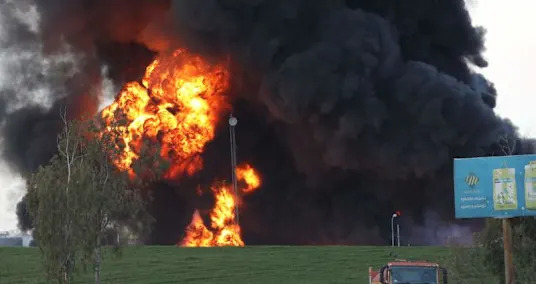
BEHIND THE LINES: Despite setbacks, Iraq’s Iranian-backed militias continue to thrive politically, posing a lasting threat to Israel’s security.
This week, the government of Iraq announced a decision to freeze assets held by the Lebanese Hezbollah organization and the Yemeni Ansar Allah (Houthis) group. The move was rapidly hailed as a major step forward, signaling Baghdad’s determination to distance itself from Iran’s regional network of militias.
Within hours, however, the government reversed its decision, with the Prime Minister’s Media Office asserting that an “error” had been made. This incident (or non-incident) demonstrated precisely the opposite of what had presumably been intended.
It showed the extent to which Iran-supported militias continue to play a key role in Iraqi governance, and are able and willing to act to prevent any moves to curtail or reduce the power and the capacities of their allies.
This is not a matter of importance only concerning internal Iraqi affairs. As Iran’s regional axis seeks rapidly to rebuild itself following the losses suffered during the two-year war against Israel, there is there is mounting concern in Jerusalem that the militias’ ongoing strength in Iraq could mean the country’s western deserts might be used as a launching area either by the militias, or their Iranian backers, in the event of renewed hostilities between Israel and Iran.

While Iraq’s militias stayed out of the previous round, following a brief intervention in late 2023, there is no reason to assume that this will be repeated. With the loss of Syria, Iraq has taken on added importance to Tehran.
It has long been known to Israel that the militias have missiles deployed in the large deserts close to Iraq’s western borders. The distance from western Iraq to Israel’s north is only 400 km. This relatively close proximity would enable the militias to launch a wide array of drones and missiles, which would quickly reach Israeli airspace.
Although there is a general impression in Israel that the Iran-led militia array has been defeated in the course of the last two years, or at least has suffered severe setbacks, this is not entirely supported by the facts. In the Iraqi case, the militias have made significant advances in recent months.
As a result, the hope that an increasingly stable internal Iraqi political scene might induce or coerce Iran-supported armed groups to voluntarily disarm and become exclusively political organizations seems misplaced. Rather, it is the militias themselves, in their political iteration, who are moving forward.
In the November Iraqi elections, parties linked to the Shi’ite militias performed well. The Sadiqoun bloc, associated with the Asaib Ahl al-Haq (AH) militia, led by Qais al-Khazali, won 27 seats in the 329-seat parliament. Asaib Ahl al Haq is one of the most active of the pro-Iran militias and has been involved in abductions and murders of Westerners.
The Badr Organization, the oldest and among the most established of the Iran-linked Shi’ite militias (and one which, unlike AH, remains undesignated as a terror organization by the US government), won 18 seats. The Huquq (Rights) list, linked to the Ktaeb Hezbollah (KH) group, won six seats. KH was responsible for the kidnapping, imprisonment, and torture of Elizabeth Tsurkov, an Israeli citizen who was released in September after 903 days in captivity.
All three of these militias are component elements within the Coordination Framework (CF), the largest single grouping within the Iraqi parliament. This faction backed the current government. Prime Minister Mohammed Shia al-Sudani, whose Reconstruction and Development Bloc won 46 seats, will be unable to form a new administration without the CF’s backing.
The CF brings together all the main Shi’ite militias into a single list, alongside several non-armed factions. The most powerful player within the Framework is former Prime Minister Nouri al-Maliki. While not a militia leader himself, he is closely linked to the armed groups and acts in their interest, seeking to embed their representatives within a broader political framework in order to increase their ability to shape policy and guard them from any legal efforts against them.
On November 18, following the elections, Sudani announced that his faction would join with the CF, giving the joint bloc the command of 165 seats and making it almost certainly the faction around which the next government will be formed.
Such a government will continue to obey the demands of the militias in areas crucial to them, as seen, for example, in the move to reverse the decision on the Houthis and Lebanese Hezbollah.
The political direction in Iraq demonstrated the extent to which the Iranian model for the seeding of proxy political and military power in Arab states remains unbroken, and essentially unchanged, despite the events of the last two years.
Following the Gaza ceasefire on October 10, and the previous ceasefires agreed by Iran in June of this year, and Hezbollah in November 2024, it was widely predicted by Israeli observers that Iran must surely adopt a new national strategy, the approach based on proxies having been so clearly defeated.
It appears, however, that Iran does not share this view. The Iraqi example shows the way that this model continues to work, combining electoral power with paramilitary muscle and extensive conventional military capacities.
The Iran-led element is quite content to allow large swathes of the political and societal life of the country to continue without its interference. But when issues arise of importance to this structure, no other force can stand against it or contradict its will.
As an article in the Arab Weekly described it succinctly this week: Iraq currently lives under “a system in which the formal state is largely a framework through which powerful political and militia networks operate.”
What does this mean for Israel? First of all, the somewhat triumphalist and delusional rhetoric that followed the ceasefire in Gaza should be retired forthwith. The Iran-led regional bloc and its project have not been destroyed, though it received serious setbacks as a result of the last two years of war. The latest events in Iraq show that it is advancing once again.
NEUESTE BEITRÄGE
- 1
 The Hybrid Volkswagen ID. ERA 9X Will Become the Brand’s New Flagship in China15.01.2026
 - 2Early diagnosis leads King Charles to scale back cancer treatment in the new year12.12.2025
- 3Bowen Yang is reportedly leaving 'Saturday Night Live' after this week's episode19.12.2025
- 4Step by step instructions to Get a good deal on Your Rooftop Substitution Venture17.10.2023
- 5Insane Realities That Will Make You Reconsider How you might interpret History30.06.2023


Ähnliche Artikel
- Artemis 2 captures historic 'Earthset' photo | Space photo of the day for April 7, 202607.04.2026
- Tesla Germany Registrations Quadruple to 9,252 Vehicles in Best March Ever07.04.2026
- What's going on with Katseye? The Manon Bannerman hiatus drama, explained.07.04.2026
- Two IDF officers, civilian face indictment in alleged Gaza aid-truck smuggling scheme07.04.2026
- West Palm Beach Shorecrest, renderings of downtown waterfront condo07.04.2026
- Artemis II astronauts make long-distance call to the space station as they head home from the moon07.04.2026
- Tuesday, April 7. Russia’s War On Ukraine: News And Information From Ukraine07.04.2026
- The Eastern Bongo, Kenya’s Rare Forest Antelope on the Brink07.04.2026
- U.K. blocks Kanye West from entering Britain to headline now canceled festival: What led to the ban07.04.2026
- Russia confirms 16 Cameroonian soldiers killed in Ukraine war07.04.2026
- First Phosphate advances battery-grade phosphate project as analysts highlight strategic Federal support07.04.2026
- After fleeing past Hezbollah fighting, some Israelis on northern border vow to stay07.04.2026
- 'Unreal' solar eclipse: Artemis 2 crew just saw one of the rarest sights in spaceflight history07.04.2026
- Chinese construction workers in Israel: 'I’d rather be bombed than live in poverty'07.04.2026
- Broken toilet, T-shirts on windows and collecting saliva: The weirdness of daily life aboard Orion07.04.2026
- Czech Republic caps fuel prices amid Iran war energy crisis07.04.2026
- NASA releases stunning new images captured by the Artemis II moon mission, including 'Earthset' and a solar eclipse from space07.04.2026
- Amid Iran war, 53 of Israel's future scientists showcase projects in Jerusalem contest07.04.2026
- Iranian-linked drone attack kills Kurdish couple in northern Iraq07.04.2026
- Thousands of small fish defy gravity to climb Congo waterfall07.04.2026